
3D Secure and SCA on Visa Deposits
 Available in US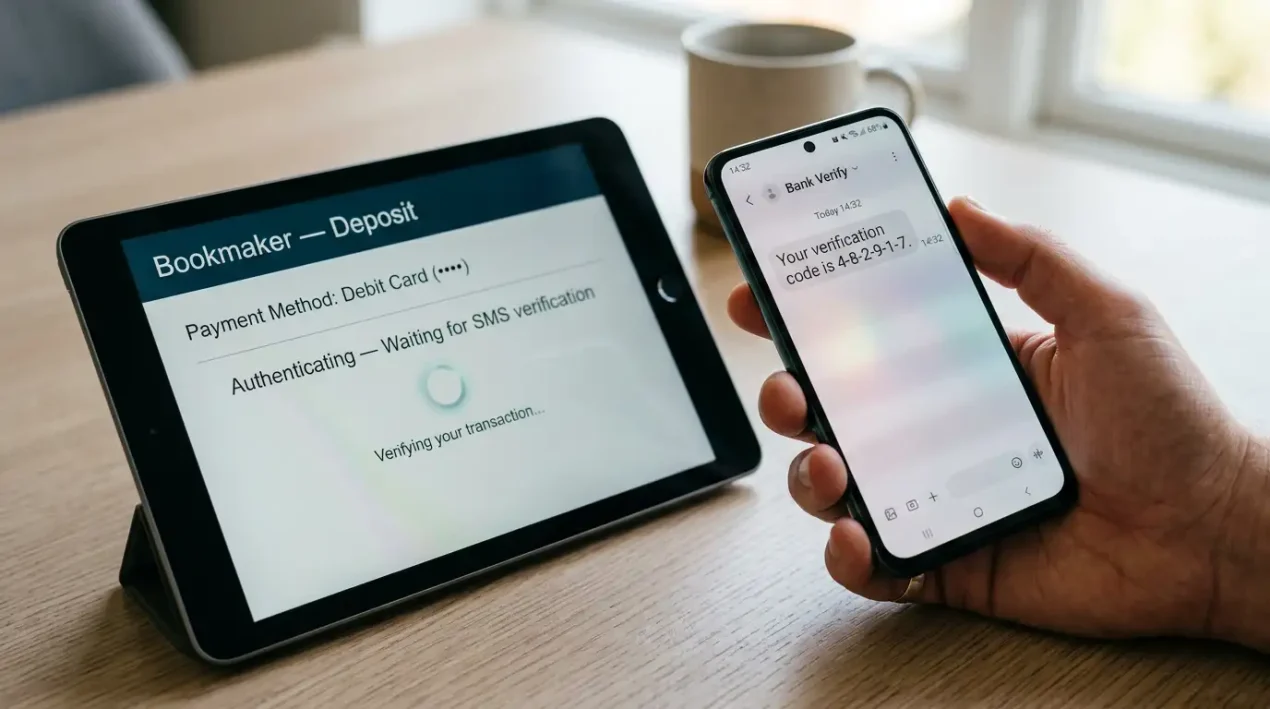
The OTP nobody asked for and everyone needs
It always happens at the worst possible moment. Two minutes before a race, the deposit screen freezes on the SMS challenge, the OTP arrives ten seconds too late, and the bet you wanted to place has already started without you. I’ve watched friends curse 3D Secure as if the whole point of the protocol was to ruin their afternoon, when in fact it’s the protocol that’s standing between them and a much worse outcome – somebody else using their card details to fund somebody else’s bookmaker account.
What gets misunderstood is what the OTP is actually verifying. It isn’t checking that you have permission to bet, it isn’t checking that the merchant is legitimate, and it isn’t even checking that you authorised this specific deposit. It’s verifying one narrow thing: that the person typing the card details is in possession of the device or credential bound to the cardholder. Once you understand that boundary, the failure modes start making sense.
Safe betting begins on our website.
What 3D Secure does and where it sits in the flow
3D Secure is a card-present-style authentication layer for online transactions. The “3D” stands for three domains – the issuer, the acquirer and the interoperability domain run by the scheme – and the protocol is what stitches them together at the moment of authentication. The current generation, 3DS 2.x, is the one almost every Australian Visa transaction uses today, and it’s a meaningful improvement on the original 1.x version everyone hated for its clunky redirects and timeouts.
In a Visa Debit deposit at an Australian bookmaker, 3DS sits between the merchant’s payment form and the issuer’s authorisation system. You enter your card details, the merchant fires off an authorisation request, and before the issuer commits to approving or declining, it routes you through 3DS for an authentication challenge. If the challenge succeeds, the issuer treats the transaction as cardholder-verified and shifts liability for any fraud claim from the merchant to itself. If the challenge fails or times out, the transaction is declined.
The shift to 3DS 2.x introduced two paths through the protocol: a frictionless flow where the issuer skips the visible challenge based on risk signals from the merchant, and a challenge flow where the cardholder has to actively prove possession. Bookmaker deposits don’t qualify as low-risk, so they almost always end up in the challenge flow.
Why bookmaker deposits trigger the challenge nearly every time
The frictionless path relies on the issuer being comfortable that the transaction matches a low-risk pattern. Bookmaker deposits don’t match any low-risk pattern. Merchant category code 7995 is flagged as elevated risk in every issuer’s model, transaction values are highly variable, and the same cardholder might initiate three deposits in fifteen minutes during a major event – exactly the velocity that frictionless flows escalate.
Your Visa deposit at an Australian bookmaker is going to hit the challenge flow basically every single time. That’s not a sign your bank doesn’t trust you; it’s the issuer’s risk engine doing what it’s supposed to do for a category that scheme rules treat as elevated. Resigning yourself to the OTP at every deposit is the right mental model.
Smartphone penetration in Australia sits at about ninety-six per cent for adults aged eighteen to sixty-four, which is the demographic underpinning the entire SCA design. The protocol assumes the cardholder has a device that can receive an SMS or run a mobile banking app, and on that assumption it builds in challenges that range from a one-time passcode to in-app biometric confirmation. If your phone has signal and is unlocked, the challenge takes about ten seconds. If it doesn’t, you’re stuck.
The risk-based decisions sitting under the hood
The challenge that pops up on your phone isn’t the same every time, and it isn’t picked at random. The issuer’s risk engine evaluates a cluster of signals on every transaction – device fingerprint, IP geolocation, transaction amount versus typical pattern, time of day, frequency since last attempt, whether the merchant has been seen before from this device, and several dozen others – and chooses an authentication method calibrated to the perceived risk.
For a low-friction case the engine might serve a silent device check that completes without you noticing. For a moderate case you’ll get an SMS OTP. For a higher-risk case the issuer might escalate to a banking-app push notification with biometric confirmation, or in extreme cases an out-of-band call from the fraud team. The point is that the same cardholder making the same deposit at the same bookmaker can land on any of those rungs depending on the broader signal profile that day.
This is why the same person who breezes through deposits on their home Wi-Fi in the evening sometimes hits a wall when they try to deposit from a new location during the day. The risk engine doesn’t recognise the new context, escalates the authentication tier, and your familiar SMS-based flow turns into a banking-app challenge you weren’t expecting. Once your bank app is the gatekeeper, having it logged in and ready before you start the deposit saves you a frustrating round trip.
How to recover when the OTP doesn’t arrive
Failed challenges are recoverable but only if you handle them in the right sequence. The wrong sequence, which is what most people do, is to retry the deposit immediately when the OTP doesn’t arrive. That fires off another authorisation, your bookmaker’s velocity rules see two attempts in fast succession, and now you’re climbing two unrelated obstacles at once.
The right sequence is to first wait out the timeout. 3DS challenges typically expire after three to five minutes, and your card stays in a quasi-locked state until the issuer’s system clears the previous attempt. Trying again before that clears just generates another decline. Once the timeout has passed, check your phone signal and your SMS app – including the spam folder, which has been the home of more late-arriving OTPs than people realise. If the OTP still hasn’t shown, switch to your bank’s mobile app and look for a pending authentication request inside the app rather than waiting for the SMS.
If multiple attempts in a short window have failed, your card may have been temporarily locked by the issuer’s fraud team. The unlock is usually automatic after twenty to thirty minutes, but it can also require you to confirm by phone or app. The critical thing is to stop hitting “deposit” while the lock is in place. Each new attempt resets the timer and prolongs your exposure to the lock. Once you can demonstrate that the attempts came from you – which is what the issuer is asking – the card returns to normal service and the OTP flow resumes.
The interaction with verification and pre-creation rules
Two systems operate in parallel that occasionally get confused with one another. The 3DS challenge is at the card-scheme level. The customer identification procedure is at the gambling-regulator level – the rules that took effect on 29 September 2024 require operators to complete identity verification before account creation or service provision. They’re entirely separate, but a failure in one can look like a failure in the other.
What that means in practice is that if you’ve just opened a bookmaker account and your first deposit gets bounced after a successful 3DS challenge, the issue is probably on the verification side rather than the scheme side. The card scheme is happy with you, but the operator is holding the deposit pending a final verification check. That manifests as a slightly different error pattern – the deposit attempts authorise on the card, then get reversed seconds later by the merchant. If you see authorisation followed by reversal, look at your operator account status before you blame the OTP.
I’ve also seen people convinced their card was being declined when in fact the operator was rejecting the deposit because of a name-match issue between their verified identity and their card’s billing details. The 3DS layer doesn’t see that – it just verifies possession. The operator’s KYC layer sees it and refuses. For the deeper handling of name mismatches and how they interact with both KYC and SCA, the stored-credentials and one-time-entry analysis is the right next step.
Device binding and what saved cards do to the SCA flow
Saving a card at a bookmaker doesn’t get you out of SCA, but it does change the flow. When you save a card, the merchant stores a token rather than the full card number, and that token gets associated with your device fingerprint. On subsequent deposits, the issuer’s risk engine sees a familiar device making a transaction with a tokenised card, and the frictionless path becomes more likely – sometimes the OTP is skipped entirely, sometimes the challenge gets reduced to a silent device check.
The trade-off is that the device binding is fragile. Reinstall the bookmaker’s app, factory-reset your phone, switch from mobile data to Wi-Fi at a new location, or change your phone – and the device fingerprint resets, which means the next deposit looks like a brand-new device transaction to the risk engine. You’ll get the full challenge flow until enough successful attempts have rebuilt the trust signal. People who’ve grown used to one-tap deposits on a saved card are sometimes baffled by the sudden return of OTPs after they upgraded their phone, but it’s the binding resetting, not the bookmaker changing the rules.
Recurring or stored-credentials transactions – where the merchant initiates a charge based on prior cardholder consent – sit in a different SCA category. They’re exempt from the challenge flow under most schemes’ rules, on the grounds that the cardholder already authenticated when they originally agreed to the recurring arrangement. Bookmakers very rarely use this mode for deposits, because the consent model doesn’t fit one-off deposits and operators don’t want the liability shift that comes with merchant-initiated charges. So in practice, every deposit you make is a fresh customer-initiated transaction and goes through SCA from scratch.
Living with SCA without losing your patience
The discipline that pays off is treating SCA as part of the deposit, not as an interruption to it. Have your phone unlocked and within reach before you click confirm. Keep your bank’s app installed and logged in, because the fallback when SMS fails is almost always going to be an in-app challenge. Don’t initiate deposits while you’re switching between Wi-Fi networks or moving in and out of mobile coverage; the network instability raises your risk score and sometimes drops the challenge entirely.
Compare this to other methods like Visa vs bank transfers.
For high-stakes moments – the minutes before a major event, the closing seconds of a market – pre-fund your account well in advance rather than relying on a last-minute deposit. SCA is not what you want to be negotiating with at the moment a market is about to settle. The five seconds the OTP costs you on a quiet weeknight can become five minutes of failed retries when the network is congested and the issuer’s risk engine is on alert.
If my phone has no signal, can I still complete an SCA challenge for a Visa betting deposit?
Sometimes. SMS-based challenges fail without signal, but if your bank app supports in-app authentication and you’re connected to Wi-Fi, the challenge can still complete. The fallback path varies by issuer. If your usual bank uses SMS as the primary channel and offers no app-based alternative, no signal means no SCA, which means no deposit.
Why do some bookmakers re-trigger 3D Secure on every deposit and others don’t?
The difference comes from how each operator structures its merchant integration. Some configure their gateway to request SCA on every transaction, which is the safer default. Others use exemptions where the prior transaction history of a saved card lets them skip the challenge for low-risk follow-ups. The choice sits on the merchant side, not the cardholder side.
Does SCA apply to recurring or saved-card deposits at AU bookmakers?
In theory recurring transactions are exempt from SCA, but bookmakers very rarely use that pattern because deposits don’t fit the recurring-payment model and operators want to avoid the liability shift. In practice every deposit you make is treated as a fresh customer-initiated transaction and runs through full SCA, even when the card details are saved.
