
PayID for Betting: NPP Rails Explained
 Available in US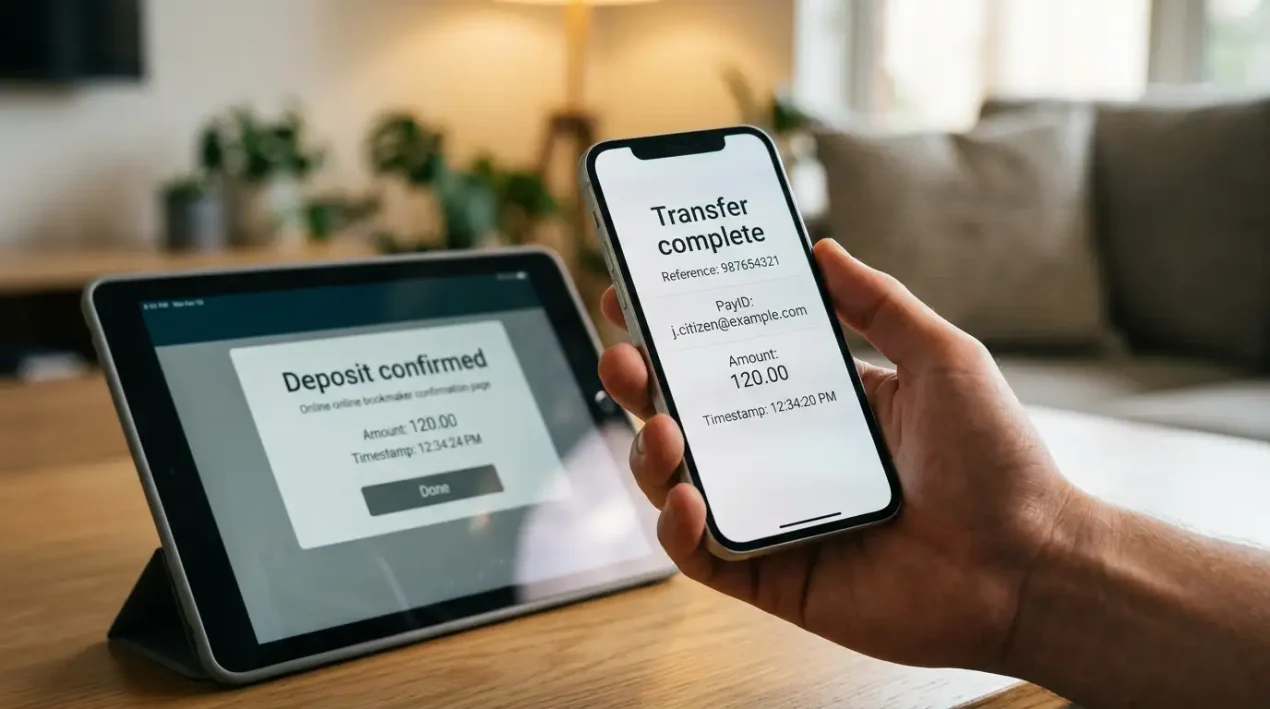
Why PayID stopped being a curiosity and became the default
The first time I sent a PayID deposit to a bookmaker, I was pretty sure something had gone wrong. I’d hit confirm, watched the screen, and before I could put the phone down the funds were already in my betting balance. No pending status, no “should clear within fifteen minutes”, no email asking me to confirm the transaction. It just landed. That experience is the entire reason PayID is now the rail most punters end up on after one or two friction points with cards.
Sportsbet’s decision in March 2025 to stop accepting direct bank transfer deposits accelerated the shift. They didn’t quietly de-prioritise the option – they pulled it entirely and pointed everyone at PayID instead. Other operators have followed at varying speeds, but the direction of travel is unmistakable. So if you’re going to deposit at an Australian bookmaker without using a card in 2026, PayID is what you’re using whether you’ve thought about it consciously or not. The mechanics underneath are worth understanding.
Explore alternatives on this card guide.
What PayID actually is and what it isn’t
PayID is a directory service, not a payment method. The actual money movement happens on the New Payments Platform – Australia’s real-time payments rail – and the PayID layer is what lets you point a transfer at a phone number, an email address or an ABN instead of a BSB and account number. The directory does the lookup, finds the underlying account, and the NPP delivers the funds to it.
What that distinction means in practice is that PayID inherits the speed and finality of the NPP, but it adds a usability layer that genuinely changes how people behave. Typing a phone number is faster and less error-prone than typing a six-digit BSB and a nine-digit account number. The directory also confirms the account holder’s name back to you before you commit, which catches typos and impersonations before money moves rather than after.
The NPP itself was already doing serious volume before bookmakers leaned into PayID. The platform processed more than 1.4 billion transactions worth more than AUD 220 billion in 2023 alone, with year-on-year growth of about twenty-eight per cent. The infrastructure was built to handle the entirety of consumer payments at sub-second settlement, so adding bookmaker deposits to its workload is barely a rounding error.
How NPP and Osko sit underneath
NPP is the rail. Osko is the messaging service that runs on top of it for fast retail payments, the same way that emails ride on SMTP without most people knowing what SMTP is. When you send a PayID deposit, your bank’s mobile app composes an Osko message, validates it against the PayID directory, and dispatches it down the NPP rail to the receiving institution – which in the bookmaker’s case is whoever holds their merchant settlement account.
The settlement is real-time and irrevocable. Once the receiving bank acknowledges the message, the funds are credited to the destination account and the transaction can’t be unwound by your bank without the receiver’s cooperation. That’s a meaningful difference from a card transaction, which sits in an authorised state for a day or two before settling and can be reversed by the issuer with relative ease. PayID money has moved by the time you finish blinking.
For the bookmaker, the upshot is that they get cleared funds immediately. They don’t have to wait for settlement, they don’t pay interchange, and they don’t carry the chargeback risk that comes with card rails. That’s a significant cost saving on their side, and some of it gets passed back to the customer in the form of higher deposit limits and fewer reasons for the operator to reject the transaction. The cost saving is one reason operators have been quietly steering punters toward PayID for years.
Setting PayID up the right way for betting
You set up PayID inside your bank’s app, not at the bookmaker. Most major Australian banks support it natively now, and the setup is a one-time exercise: pick which contact detail to register (mobile number, email, ABN), confirm via OTP, and link it to whichever account you want incoming funds to land in. The directory entry is unique – only one PayID per identifier, only one account per PayID – but you can register multiple PayIDs (one for your phone number, one for your email) all pointing at the same account if that suits.
For betting purposes, the question worth thinking about is whether you want your everyday PayID receiving betting deposits and refunds, or whether you’d rather isolate that traffic. There’s nothing technically wrong with using your main mobile-number PayID for bookmaker activity – it works fine. The argument for separating it is the audit trail. If the ATO ever asks you to characterise activity in a particular account, having all gambling-related transactions concentrated in one account makes the conversation cleaner. It also lets you set spending controls more aggressively on that account without disturbing your salary or rent.
The pre-creation customer identification rules that took effect on 29 September 2024 mean the bookmaker has already verified your identity before they accept any PayID transfer from you. So the name on your PayID has to match the name on your bookmaker account or the deposit will get held for review. This trips people up if their bank account is in a slightly different format from their bookmaker registration – middle name on one, missing on the other; legal name on one, common name on the other.
What happens on the bookmaker’s side
From the operator’s perspective, accepting a PayID deposit looks roughly like this: they generate a unique PayID for your account (usually an email address tied to your customer ID), display it on the deposit screen, and wait for the inbound transfer. When the NPP delivers the funds, the operator’s payment gateway matches the incoming reference to your account and credits the balance. The whole loop closes in seconds.
What sometimes goes wrong is the matching. If you transfer to a generic operator PayID without including the right reference number, or if the reference gets truncated, the funds arrive but the system can’t tell whose account to credit. That manifests on your end as money debited from your bank but no balance increase at the bookmaker. The fix is always the same – contact the operator’s support with the transaction reference from your bank, and they’ll manually match it inside an hour or two. It’s annoying but it’s recoverable, which is more than can be said for some failure modes on cards.
The other operator-side wrinkle is that not all bookmakers run a true real-time integration. Some accept PayID but batch-process the receipts through a payments aggregator, which adds a delay of anywhere from a few minutes to fifteen. You can’t always tell from the deposit screen which mode the operator is using, but if your first deposit doesn’t land in seconds, you’ve got the slower variant and you should plan accordingly.
The failure modes worth knowing about
PayID isn’t immune to friction, it’s just a different set of friction points than cards. Three failure modes account for almost everything that goes wrong.
The first is name-mismatch warnings. When you initiate the transfer, your banking app shows the registered name on the PayID and asks you to confirm. If the name doesn’t match what you expect the bookmaker to be, the warning is doing its job – it’s catching a typo in the PayID or a misdirected recipient. Don’t override it. The same warning sometimes flags genuine bookmaker PayIDs that happen to be registered under a corporate name you don’t recognise (a parent company, a payments processor on the operator’s behalf), so before you hit confirm, cross-check the deposit reference on the bookmaker’s screen against the bank app’s destination details.
The second is daily limits at your sending bank. Every Australian bank caps how much can leave through PayID/Osko per day – usually somewhere between AU$10,000 and AU$25,000 depending on the institution, but the floor on some accounts is much lower if the customer hasn’t increased it. Hit that ceiling and your transfer simply fails, with no clue from the bookmaker side that anything is wrong. If a deposit doesn’t go through and your card alternative isn’t great either, check your sending limit before chasing the operator.
The third is name-format edge cases. If your bank account is registered as “Robert J. Smith” and your bookmaker account is “Bob Smith”, the PayID will land but the bookmaker’s automated matching may flag it for manual review. That delay can stretch to a day if it falls over a weekend. The fix is to make sure the legal-name field on both sides agrees character for character, including middle names and any hyphens.
How PayID stacks against cards in real use
The honest comparison isn’t about which rail is better – it’s about which trade-offs each one imposes. Cards bring you scheme-level chargeback rights, recognised fraud-monitoring infrastructure, and a long settlement window that sometimes works in your favour. PayID brings you instant settlement, no card-scheme dependencies, no MCC routing decisions, and zero exposure to the credit ban because the rail can’t carry credit at all.
Review our head-to-head on Visa vs PayID for deposits.
For a punter making routine deposits at a licensed Australian bookmaker, PayID is now the lower-friction default. The only meaningful argument for sticking with Visa Debit is if you specifically want the option to chargeback a transaction, and even that protection is significantly narrower for gambling deposits than people assume. For everything else, the rail that settles in seconds and ignores MCC 7995 entirely is going to give you fewer headaches over a year of betting than one that depends on your bank’s mood about merchant category 7995. The detailed comparison against bank transfer specifically is covered in the analysis of withdrawal rails.
Can I create a PayID just for betting and keep it separate from salary?
Yes, and it’s worth doing. You can register multiple PayIDs against the same bank account or against different accounts at the same institution. Setting up an email-based PayID linked to a separate transaction account that you use only for wagering keeps your audit trail clean and lets you apply spending controls to that account without affecting your main banking.
Why does PayID sometimes show a name mismatch warning at a bookmaker?
The warning compares the name on your sending bank account to the name registered against the destination PayID. Bookmakers sometimes register their PayIDs under a corporate name that differs from their consumer-facing brand – a parent company or a payments processor. Cross-check the destination details against the deposit reference the bookmaker shows on its screen before overriding the warning.
Is there a daily PayID limit set by my bank?
Yes. Every Australian bank caps PayID and Osko transfers at the account level, typically between AU$10,000 and AU$25,000 a day, though the default on some accounts can be much lower until you raise it. Hitting the ceiling produces a transfer failure that the bookmaker can’t see, so check your sending limit if a deposit fails and your bank balance has the funds.
