
Visa Direct vs. Bank Transfer Withdrawals
 Available in US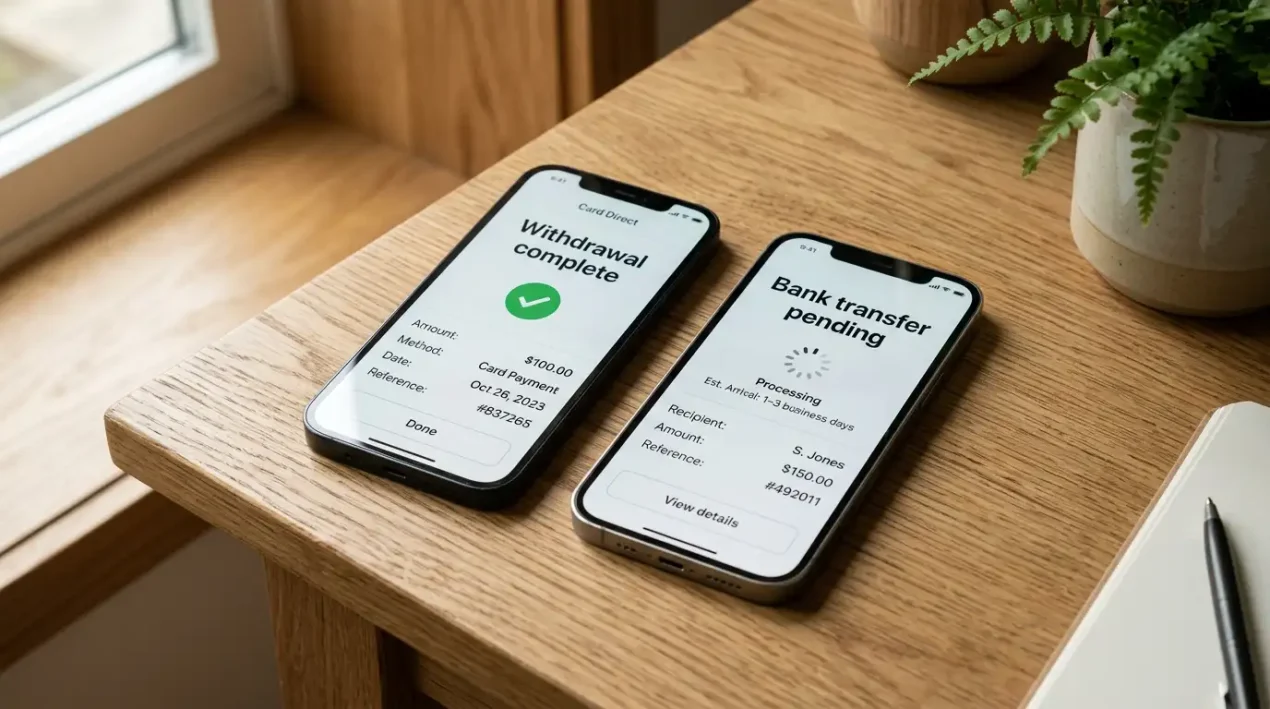
The withdrawal that used to take five days
The first time I withdrew via Visa Direct, I was certain something had broken. I’d hit the payout button on a Saturday afternoon for AU$340 of weekend winnings, expected the usual three-to-five-business-day wait, and watched the funds appear in my Visa Debit balance in about twenty minutes. No banking-day delays, no settlement window, no Monday-morning anxiety wondering whether the bookmaker had actually sent the money. The cash was there before I’d put the phone down.
That experience is now standard at the operators that have invested in Visa Direct integration, but it’s not universal – some bookmakers still rely on traditional bank transfer for payouts, and the customer experience between the two rails is night and day. The choice between push-to-card payouts and bank transfer matters more for withdrawals than it does for deposits, because the speed differential is bigger and the operational friction is more visible.
So this piece walks through what Visa Direct actually does for Australian bookmaker withdrawals in 2026, where the limits sit, when bank transfer still makes sense, and the practical differences punters need to know before they pick a rail.
Fast payout info on our homepage.
What Visa Direct actually is
Visa Direct is the push-to-card service operated by Visa that lets businesses send money to a customer’s Visa-branded card. From the customer’s perspective it looks like a deposit landing on their bank account, but the underlying mechanics are different. Instead of the bookmaker initiating a bank transfer through the standard payment rails, they push funds directly to the card via Visa’s network, which clears in near real-time.
The technology has been around for years but the Australian licensee adoption has accelerated since 2023 as customer-experience teams realised the rail produced meaningful retention benefits. Customers who get paid out within an hour of requesting a withdrawal are measurably more likely to redeposit and stay engaged with the operator than customers who wait three days. The 24-hour-payout pledge that several major Australian operators have made over the past two years is built on Visa Direct as the underlying infrastructure.
The fact that Visa is the dominant card scheme – over 3.3 billion cards in 2026 and 52.8% of all banking cards globally – means push-to-card has a wide reach. If you have any Visa-branded debit or prepaid card, you can usually receive Visa Direct payouts. The exceptions are some virtual cards and specific prepaid products that don’t sit on the Visa Direct routing tables, which I’ll come back to.
How push-to-card differs from a regular bank transfer
The mechanical difference is which rail moves the money. A bank-transfer payout uses the New Payments Platform or older overnight-batch infrastructure to move funds from the bookmaker’s bank to your bank, which takes seconds (NPP) to days (legacy batch) depending on the operator’s setup. A Visa Direct payout uses Visa’s card-network rails to push funds directly to the card, which clears within minutes regardless of the time of day.
The customer-side appearance is also different. Bank transfer payouts show up in your transaction account as a regular incoming transfer, with the bookmaker’s name as the originator. Visa Direct payouts show up as a credit on your card account, often labelled differently (sometimes as “Visa Direct credit” or with the originator’s reference). Both methods produce the same end-state – money in your account – but the route and timing differ.
The other meaningful difference is operating hours. Bank transfer over NPP works 24/7. Visa Direct works 24/7. Older-style bank transfers (which a few smaller licensees still use) only process on business days, which is why a Friday-afternoon withdrawal from those operators traditionally landed on Tuesday rather than the next morning. The shift to NPP and Visa Direct has largely eliminated this gap, but it’s worth confirming with your specific operator what their payout rail is.
Visa Direct withdrawal limits and where they sit
Visa Direct has scheme-level limits that the bookmaker can choose to apply within. The most common limits at Australian operators are AU$5,000 per transaction and AU$10,000 per day, though the specifics vary. Smaller operators sometimes set lower limits to manage their own cash-flow exposure; larger operators with deeper liquidity offer higher limits.
The interaction with AUSTRAC’s threshold rules matters here. The AML/CTF Amendment Act 2024 dropped the daily KYC threshold for wagering operators from AU$10,000 to AU$5,000 effective 2026, and that threshold applies to total designated services per day, including withdrawals. So a Visa Direct payout of AU$5,000 sits exactly on the threshold and may trigger enhanced procedures depending on how the operator has implemented their compliance framework.
What this means in practice is that withdrawals of AU$5,000 or above will often be paused for compliance review even on Visa Direct. The review usually doesn’t change the eventual payout amount, but it adds anywhere from a few hours to a couple of days to the timing. Smaller withdrawals – say, AU$500 to AU$2,000 – typically clear through Visa Direct within minutes with no manual intervention.
When bank transfer still makes sense
Despite the speed advantage of Visa Direct, there are cases where bank transfer is the better choice. The biggest one is withdrawal size. Visa Direct’s per-transaction caps mean a AU$15,000 withdrawal has to be split across multiple transactions, each potentially triggering its own compliance review. Bank transfer over NPP can move the same amount in one transaction (subject to the operator’s own daily limits and any sending-bank constraints).
The other case is when your card is a virtual card or a prepaid product that doesn’t support Visa Direct inbound. Some virtual cards from neobanks aren’t on the Visa Direct routing tables, which means a push-to-card transaction will fail. The bookmaker’s payment system usually catches this and falls back to bank transfer, but the failure can add a day or two to the eventual payout.
A third case is if your card has been reissued or expired since you registered it with the bookmaker. The Visa Direct routing relies on the token associated with the original card, and if the card is no longer active, the push will fail. Bank transfer doesn’t have this dependency – it routes to your bank account directly, so the card status is irrelevant.
For punters running multiple operator accounts, bank transfer can also be cleaner from an audit-trail perspective. Bank statements show wagering payouts as inbound transfers from named operators, while Visa Direct credits sometimes appear less clearly. This isn’t a regulatory concern but it can affect personal record-keeping.
The 24-hour-payout pledge and how Visa Direct enables it
Several major Australian operators have committed publicly to processing withdrawals within 24 hours, and Visa Direct is the rail that makes that pledge realistic. Without push-to-card, the operator depends on bank-transfer infrastructure that has its own settlement windows and operating hours, and the 24-hour commitment becomes harder to keep on weekends and holidays.
The compliance picture matters here too. ACMA’s 2024-25 enforcement work – ten new investigations opened, ten closed, including the AU$1 million Betchoice fine plus a mandatory two-year independent review – has reinforced that operators need to honour their stated terms, including payout commitments. An operator that pledges 24-hour withdrawals and consistently fails to deliver is exposed to regulatory pressure beyond the customer-relationship damage.
Visa Direct doesn’t make the compliance review part of the workflow faster – that’s still a human review for above-threshold withdrawals – but it does eliminate the rail-side delays that used to dominate withdrawal timing. The bottleneck has moved from “the bank transfer hasn’t cleared” to “the compliance team is reviewing the documentation”, which is a different kind of waiting and usually shorter for punters with clean accounts.
What to do when Visa Direct fails
The most common failure mode is the receiving card not being eligible for inbound transfers. If your withdrawal request is accepted by the bookmaker but the funds never appear, the operator usually has a fallback flow that converts the payout to bank transfer automatically. This adds time but doesn’t lose the funds.
If the failure is on the bookmaker side – a payment-gateway issue, a routing problem, an internal error – the funds are returned to your wagering balance and you can re-attempt. Don’t keep retrying the same rail if the first attempt failed; switch to bank transfer for that withdrawal and chase the Visa Direct issue separately through support.
The pre-creation verification rules from 29 September 2024 mean your identity is fully verified before any of this matters, so failed withdrawals don’t get stuck in a KYC limbo the way they sometimes did under the older rules. The funds are safely in the operator’s hands and will eventually reach you through one rail or another.
Where this leaves the rail choice for 2026
For most Australian punters most of the time, Visa Direct is the better withdrawal rail when it works. It’s faster, it works on weekends, and it requires no additional information beyond the card you’ve already used to deposit. Bank transfer is the right fallback for large amounts, for cards that don’t support push-to-card, or for situations where you want a clearer paper trail.
Check the typical withdrawal times for Visa users.
The honest framing is that you don’t usually have to choose – most operators offer both and pick the rail based on the situation. The choice you do have is whether to register a card that supports Visa Direct (which most modern Australian Visa Debit cards do) or to default to bank transfer for everything. For the speed differential alone, registering a Visa Direct-eligible card is worth doing.
For the deeper comparison between Visa Debit deposits and bank-transfer rails specifically on the inbound side, my piece on Visa Debit versus bank transfer at Australian bookmakers covers the deposit-side trade-offs.
Why does my Visa Direct withdrawal sometimes take longer than the operator’s quoted time?
The two most common reasons are compliance review on amounts above the AU$5,000 threshold, and your bank’s own posting policies. Some banks post incoming card credits within minutes; others batch them and post once a day. If the operator says the funds were sent at 2 PM and your bank doesn’t show them until midnight, the delay is on the bank side, not the operator side.
Can a virtual card receive a Visa Direct withdrawal?
Sometimes. It depends on the issuer’s setup. Some neobanks issue virtual cards that fully support Visa Direct inbound; others issue them as outbound-only with no inbound routing. The bookmaker’s payment system will detect this on the first attempt and either complete the push or fall back to bank transfer. If you specifically want push-to-card, register a card that supports it rather than relying on a virtual card.
Is Visa Direct affected by the AUSTRAC threshold reduction in 2026?
Yes. The AU$5,000 daily threshold applies to all designated services, including withdrawals via Visa Direct. Push-to-card payouts at or above that threshold may trigger enhanced procedures regardless of the rail’s underlying speed. Smaller withdrawals are unaffected by the threshold and clear through Visa Direct in minutes.
