
Visa Debit vs. PayID for Betting (2026)
 Available in US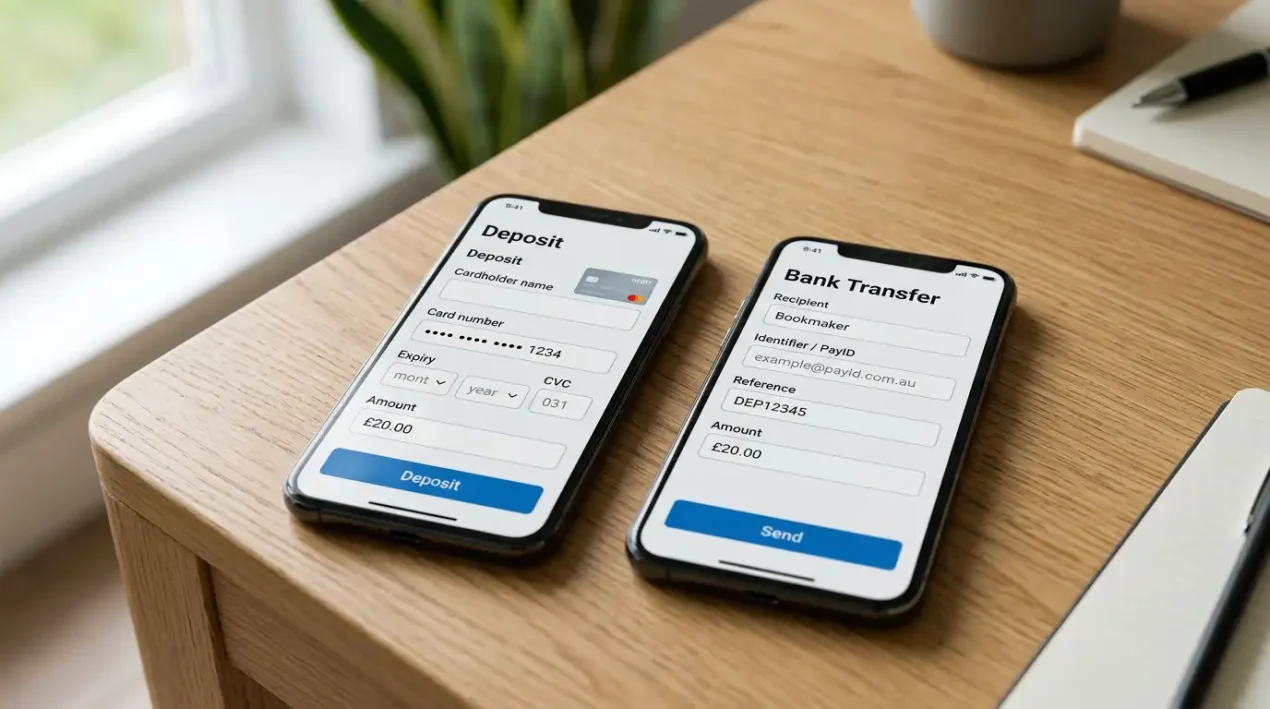
The two-rail decision punters never thought about
Until about three years ago, the deposit choice at an Australian bookmaker was barely a decision. Visa Debit was fast, PayID was experimental, and most punters defaulted to whichever card they had to hand. Then Sportsbet retired direct bank transfer in March 2025 and pointed everyone at PayID, and suddenly the rail choice mattered. The two options now compete on speed, friction, dispute rights, verification, and fee absorption – and the right answer for any individual punter depends on what they actually do.
I’ve spent the last eighteen months comparing the two rails across dozens of Australian operators, and the honest summary is that neither is universally better. There are edge cases where Visa wins decisively, edge cases where PayID wins decisively, and a large middle ground where it doesn’t matter much. The trick is knowing which case you’re in before you make the deposit, because the wrong rail at the wrong moment can cost you a deposit window, a chargeback right, or a verification step you didn’t need to trigger.
So this piece is the head-to-head comparison: Visa Debit versus PayID for Australian bookmaker deposits in 2026, what each rail actually does, and where the trade-offs land.
Choose your method on our homepage.
The two rails, side by side
Visa Debit at an Australian bookmaker uses the standard card-scheme infrastructure. You enter your card number, the bookmaker’s gateway authenticates the transaction through 3D Secure, the issuer authorises or declines based on its risk model and the credit-ban filter, and the funds settle through Visa’s network. The end-to-end timing is usually under thirty seconds for a successful authentication, but the failure modes are many.
PayID uses the New Payments Platform – Australia’s real-time payments rail. You initiate the transfer in your banking app, address it to the bookmaker’s PayID, and the funds move bank-to-bank within seconds. The rail handled over 1.4 billion transactions worth more than AU$220 billion in 2023, with continued growth since. There’s no card-scheme involvement, no MCC, no 3D Secure, and no funding-indicator check.
The architectural difference matters because it determines which failure modes apply. Visa is sensitive to MCC 7995 issuer policies, BIN-level credit detection, 3D Secure timeouts, and the broader credit-ban framework. PayID is sensitive to name mismatches, sending-bank daily limits, and reference-code accuracy at the destination. Different rails, different ways to fail, different fixes when they do.
Where Visa Debit wins
The clearest Visa Debit advantage is that you can deposit without leaving the bookmaker site. The card-entry flow keeps the punter inside the operator’s environment, completes the authentication via SMS or in-app push, and credits the wagering balance – all without switching to a banking app. For punters who deposit during live events when seconds matter, this is meaningful. PayID requires opening your banking app, finding the transfer screen, entering the operator’s PayID, including the reference code, and confirming, which is more steps even if the underlying rail is faster.
The second Visa advantage is the chargeback right. Visa scheme rules give you a defined dispute process for a narrow but real set of circumstances – fraud, services not rendered, technical failures. PayID has no equivalent dispute infrastructure. Once an NPP transfer has settled, the funds are gone and your only recourse is to ask the recipient to return them. For most punters this difference doesn’t matter because they don’t dispute deposits, but for someone who’s hit a fraud event or a services-not-rendered situation, the Visa chargeback is genuinely valuable.
The third advantage is saved cards and tokenisation. A Visa Debit registered with a bookmaker can be used for one-tap deposits indefinitely, with the merchant-initiated-transaction flow letting subsequent deposits skip the SCA challenge entirely if the operator’s implementation supports it. PayID doesn’t really have an equivalent – every transfer is a fresh action initiated from the banking app side, with the same friction every time.
Where PayID wins
The clearest PayID advantage is reliability. The rail just works. There’s no MCC 7995 to worry about, no BIN-range issues, no 3D Secure timeouts, no credit-ban filter to trigger false positives. As long as your sending bank isn’t capping you, your reference is correct, and your name matches the bookmaker’s records, the transfer clears in seconds. The failure rate I see in real-world data is dramatically lower than for Visa.
The second advantage is settlement speed. Visa transactions are technically authorised in seconds but settled over a 24 to 48-hour cycle, which is largely invisible to the punter but matters at the bookmaker’s end for cash-flow timing. PayID settles instantly and finally, which lets the bookmaker credit the balance immediately without any cash-flow exposure. That cleaner backend produces a marginally better customer experience on the front end – fewer “pending deposit” states, fewer reconciliation delays, fewer support tickets about funds that should have arrived.
The third advantage is structural separation from the credit ban. Visa transactions go through the same scheme infrastructure that the credit-card ban regulates, and the credit-related-products framework adds a verification layer to every Visa deposit. PayID is a debit-only rail by design – there’s no credit version of NPP – so the credit ban simply doesn’t apply. For operators, this means lower compliance overhead. For customers, it means fewer false-positive declines.
The fourth, often overlooked, advantage is cost to the operator. PayID transfers cost the bookmaker a fraction of what Visa transactions cost. Lower interchange means more headroom for promotional offers and operational margin, and operators have been gradually shifting their incentive structures to favour PayID – slightly faster crediting, occasionally PayID-only bonus offers, simpler verification flow.
Speed comparison in real conditions
The advertised speeds for both rails are similar – seconds to minutes. The real-world variance is bigger than the advertised numbers suggest. Visa Debit deposits clear in 5 to 30 seconds for a clean authentication and 1 to 5 minutes if 3D Secure introduces friction. PayID deposits clear in 3 to 15 seconds for the rail itself, plus whatever time it takes to switch apps and complete the transfer.
For deposits initiated during live events, the rail-switching cost matters. Punters who already have their banking app open will find PayID faster end-to-end. Punters who are deep inside the bookmaker app and don’t want to leave will find Visa faster. The rail isn’t really the bottleneck in either case – the human’s path through the apps is.
The card-payment economy in Australia is enormous – AU$1.1 trillion in 2025, with Visa as the dominant scheme – so the Visa rail has industrial-grade scale and reliability. NPP is newer but already at large scale and growing fast. Both rails are robust enough that timing concerns are usually about edge cases rather than fundamental rail health.
Verification and identity considerations
The 29 September 2024 pre-creation verification rules apply to both rails identically. You can’t deposit through either Visa Debit or PayID until you’ve completed ACIP at the operator. Once verified, both rails use the same identity foundation and check name-matches against the same data.
The rail-specific verification differences kick in at the funding-source level. Visa requires the cardholder name to match your verified identity, with a 30-day name-match window for resolving discrepancies. PayID requires the registered name on your PayID identifier to match your verified identity, with similar resolution paths but generally tighter alignment because PayID is registered against your banking-app identity rather than a separate card.
For punters with name variations across documents – middle names included or not, hyphens present or absent, common-name versus legal-name differences – PayID is sometimes the cleaner rail because the banking-app identity is usually the most carefully maintained version of the punter’s name. Visa cards often use a slightly different name format, which can produce mismatches that need resolution.
Which rail to default to
For everyday deposits below AU$1,000 at a major Australian licensee, PayID is the lower-friction default. The rail just works, the failure modes are limited, and the speed is adequate. Most punters who switch to PayID stay on it.
For deposits where you specifically want chargeback rights – live events with high deposit values, new operators you haven’t worked with before, situations where you might need to dispute – Visa Debit is the right rail. The chargeback infrastructure is genuine consumer protection that PayID doesn’t replicate.
Discover the speed of Visa Direct vs bank transfer for payouts.
For repeat deposits at the same operator, the merchant-initiated-transaction flow on Visa can be smoother than reopening the banking app every time. If you’re depositing five times a session during a live event, saving a Visa card and using one-tap re-entry is faster than initiating five PayID transfers.
For punters who genuinely don’t have a strong preference, defaulting to PayID and keeping Visa as a backup is the cleanest setup in 2026. It minimises the failure surface, takes advantage of the operator’s slight cost-side preference for PayID, and keeps the chargeback option available when it actually matters. For the deeper picture of how PayID itself works under the hood, my piece on PayID, NPP and Osko for Australian betting deposits covers the rail mechanics in detail.
If I deposit AU$200 right now, which rail will land faster?
PayID, by a small margin, if you already have your banking app open. Visa Debit is faster if you’re in the bookmaker app and don’t want to switch contexts. The rail-level differences are seconds; the human-side differences are tens of seconds. Both will land before any sensible event window closes.
Can I get the bookmaker to credit a PayID deposit before the funds settle?
No. PayID settles in real-time, so there’s no pre-settlement window to credit funds against. What you might experience as a ‘pending’ state is the bookmaker’s reconciliation engine matching the inbound transfer to your account, which usually completes within seconds but can take a few minutes if there’s a reference-code mismatch.
Are there any deposits where PayID is technically possible but I should still use Visa?
Yes – large deposits where you want preserved dispute rights, or first-time deposits at a new operator where you want the chargeback safety net while you’re testing whether the relationship works. For repeat deposits at trusted operators, PayID is usually the better default.
