
Offshore Betting & Visa Deposit Risks
 Available in US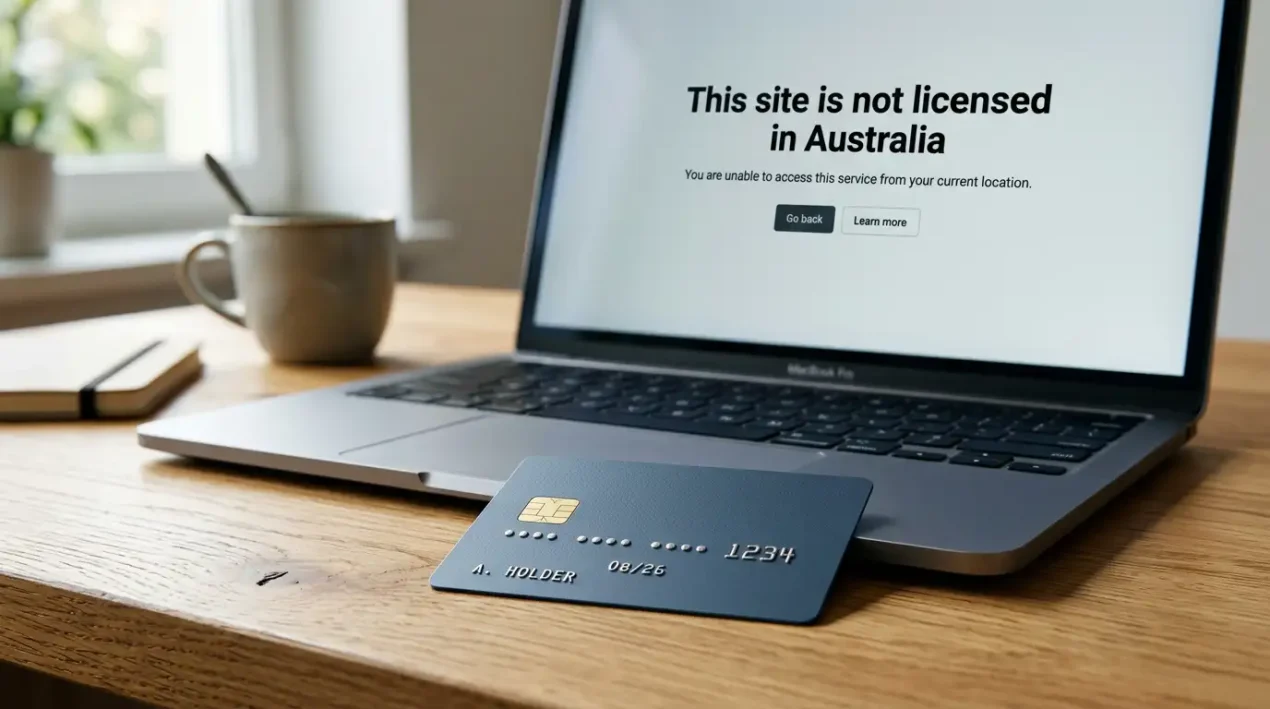
The site that takes your card and the questions that follow
One of the messages I see most often goes something like: “Site X took my Visa Debit deposit, the funds went through, the betting works fine, but I’m starting to wonder whether I’ll see my withdrawals.” The pattern is consistent enough that I want to walk through what’s actually happening when an offshore site accepts an Australian Visa deposit, why the deposit going through doesn’t mean the relationship is safe, and what the realistic options are if something goes wrong.
The core misunderstanding is that a successful deposit looks like validation. If the card processed, the site must be legitimate; if the bet placed, the site must intend to pay out; if the customer service responds, the site must be staffed. None of these inferences hold for unlicensed offshore operators targeting Australian punters. The deposit going through tells you nothing about whether the site will pay out, will handle your data carefully, or will exist as a contactable entity in six months.
This piece walks through what offshore actually means in the Australian regulatory framework, why the Visa rails don’t filter out offshore operators automatically, what happens when disputes go wrong, and the realistic recovery paths when they do.
Protect your funds on our website.
What “offshore” means in the Australian framework
An offshore bookmaker, in the Australian regulatory sense, is any operator providing wagering services to Australian residents without holding an Australian wagering licence. The Interactive Gambling Act 2001 prohibits unlicensed providers from offering most types of online gambling to Australian customers, and ACMA enforces this by investigating and disrupting unlicensed services. Over the eight years of expanded enforcement powers, around 220 unlicensed operators have left the Australian market under ACMA pressure.
The structural problem is that “leaving the market” doesn’t mean “blocking Australian customers”. Most departed operators simply changed their marketing, removed Australian-specific terms from their public-facing pages, and continued accepting Australian customers who arrived through indirect channels. The H2 Gambling Capital analysis for the industry estimated that 36 percent of online betting from Australia goes to offshore operators, up from 26 percent in 2021 – a sharp rise in the offshore share rather than a decline.
The unlicensed market is meaningful in scale. Estimated offshore wagering by Australians reached AU$3.9 billion in 2024 and is projected to grow further. Roughly one in five dollars wagered on sports in Australia goes to an unlicensed operator. The customer experience at these operators ranges from “indistinguishable from licensed” to “outright fraudulent”, and the customer typically has no way to tell the difference until they try to withdraw.
Why your Visa deposit succeeds at an offshore site
Visa’s network is global. A card issued by an Australian bank can be used at any merchant worldwide that accepts Visa, subject to the merchant’s own acceptance and the issuer’s risk-screening. Offshore wagering sites that accept Visa typically use payment processors based in jurisdictions where merchant onboarding for gambling is permitted, and from the scheme’s perspective the resulting transactions are normal cross-border merchant transactions.
The Australian-licensed-only constraint isn’t a Visa-network rule – it’s an Australian regulatory rule that applies to operators offering services in Australia, not to Visa or its acquirers. Visa’s network doesn’t have a “this merchant is unlicensed in this country” filter that catches Australian customers depositing at offshore wagering sites. The transaction looks like a legitimate cross-border purchase to the scheme.
Some Australian banks have implemented gambling blocks that catch transactions to known gambling merchants regardless of jurisdiction. These blocks help – they often catch offshore deposits – but they’re not comprehensive. Offshore operators rotate their payment processors, change their merchant descriptors, and use payment-routing arrangements that obscure the transaction’s true nature. A bank-side gambling block that worked last week might not catch the same operator this week if the merchant descriptor has changed.
Where the trouble actually starts
Most offshore deposits work fine. The customer deposits, the bet places, the customer service responds, the experience is functional. The trouble usually starts at one of three points: the verification request, the withdrawal attempt, or the operator-disappearance event.
The verification request is when the site asks for identity documents (passport, address proof, sometimes more), often after the customer has built up a balance through wins. Licensed Australian operators verify identity before account creation; offshore operators often verify only after wins, and they sometimes set the bar deliberately high to give them an excuse to freeze accounts. Customers find their balances locked pending “verification” that never completes, with the operator refusing to release funds until impossible documentation is provided.
The withdrawal attempt is when the customer tries to cash out and discovers the site doesn’t actually pay out – or pays out in tiny increments over months, or applies fees and conversions that destroy the value, or simply ignores the withdrawal request. ACMA’s chair has been blunt about this dynamic: if an offshore site decides to keep your money, there’s effectively nothing the customer can do about it.
The operator-disappearance event is when the site shuts down with customer balances still on the books. The customer logs in to find the site offline or a generic landing page, and the email addresses for support no longer respond. Funds in the operator’s wallet at the moment of shutdown are typically gone permanently, and there’s no insolvency framework that protects offshore-deposited funds the way Australian-licensed operator funds are protected.
The chargeback path and why it usually fails
The first thing customers think to do when an offshore operator won’t pay out is to chargeback the original Visa deposit. Visa’s scheme rules do allow chargebacks for several reasons that could apply, including services not rendered (the customer paid for a service they couldn’t access) and credit not processed (the operator promised a refund that didn’t happen).
The path is technically open but practically narrow. The cardholder has to contact the issuer, raise a dispute under the appropriate scheme reason code, and provide evidence. The issuer reviews the evidence, decides whether to forward the dispute to the merchant, and if forwarded, the merchant gets a chance to respond. Offshore operators sometimes respond with documentation showing that the customer received the service (a betting credit, a placed bet) and the dispute is resolved in their favour. Sometimes they don’t respond, and the dispute is resolved in the customer’s favour by default.
The time horizon matters. Visa’s chargeback rules require the cardholder to raise the dispute within a specific window from the transaction date – typically 120 days for most reason codes, with some specific codes allowing longer. Customers who try to chargeback offshore deposits months after the fact often find the dispute is time-barred regardless of the merits. And even when the dispute succeeds, the chargeback only recovers the original deposit, not winnings or interest.
The bank’s view of recurring offshore disputes
Repeated offshore-gambling chargebacks from a single cardholder eventually attract the bank’s attention. Australian banks generally cooperate with cardholders on legitimate disputes, but a pattern of multiple offshore-gambling chargebacks raises the bank’s risk view of the customer. Some banks respond by closing the customer’s account or by limiting card usage on transactions categorised under MCC 7995, the gambling merchant code.
The chargeback process also generates a record at the issuer that travels with the cardholder. Customers who have raised multiple gambling-related disputes sometimes find that future card applications at other banks are declined or come with restrictions, because the underlying credit-bureau record (or the bank’s internal database) flags the pattern. This isn’t a formal blacklist – it’s a risk-modelling outcome that compounds over time.
The realistic implication is that chargebacks are a tool to use sparingly and only when the underlying claim is strong. Trying to chargeback every losing bet at an offshore site is a path to losing the account at the bank as well as the funds at the operator. Customers who genuinely have a strong dispute (operator never paid out, operator disappeared with funds) can pursue chargeback with reasonable confidence; customers who are using chargebacks as a recovery mechanism for ordinary losses are likely to make their broader banking situation worse.
What ACMA can and can’t do
ACMA’s enforcement role is real but limited. The regulator can investigate unlicensed operators, refer site-blocking requests to internet service providers, and pursue disruption activities. ACMA’s 2024-25 compliance work documented 514 complaints in a single quarter (Q2 2024), with 463 found valid for investigation under the Interactive Gambling Act, and ten new investigations were opened in the year – all of which gives ACMA a meaningful presence in the unlicensed market.
What ACMA can’t do is recover funds for individual customers. The regulator’s mandate is to disrupt the unlicensed market, not to act as a small-claims court for offshore-gambling disputes. Customers who lose funds to an offshore operator and contact ACMA will typically receive guidance on how to dispute through their bank and on the regulatory framework, but ACMA itself has no recovery mechanism. The funds are gone in any practical sense, and the customer’s recourse is through their bank’s chargeback process or not at all.
Site-blocking has a similar effect. ACMA can request that ISPs block known unlicensed operators, and these blocks happen, but they affect future Australian access to the site rather than recovering past deposits. A customer who deposited at a site that’s subsequently blocked is no closer to their funds; the block is a forward-looking measure that protects future customers, not the existing ones.
Why H2 Gambling Capital data shows this market growing
Despite ACMA enforcement, the offshore share of Australian wagering has grown from 26 percent in 2021 to 36 percent in 2025. The growth isn’t driven by customer ignorance – most of the offshore-using customers are aware of the licensed alternatives. The drivers are specific product features that licensed Australian operators can’t offer because of the IGA framework.
The biggest single driver is online in-play betting, which the IGA prohibits at licensed Australian operators. Customers who want to bet on a sport while it’s being played online turn to offshore sites because that’s the only way to access the product. H2 Gambling Capital’s analysis for the industry found that nearly one in five offshore sports betting customers said access to live in-play betting was their primary reason for using illegal sites, which captures the structural pull factor neatly.
Other drivers include the credit-card ban (some customers want to deposit with credit and the only sites that accept it are offshore), bonus and promotion structures that licensed operators can no longer offer under Australian responsible gambling rules, and a general preference for sites without identity verification. None of these structural drivers are addressed by enforcement; they require either policy changes at the licensed-market level or sustained customer education about the trade-offs.
The realistic risk picture in 2026
The H2 Gambling Capital analysis also found that around half of offshore Australian gamblers are simultaneously registered on BetStop, the national self-exclusion register that had 49,382 total registrations and 31,838 active exclusions by the end of Q1 2025-2026. This statistic captures something important: many offshore-using customers aren’t unaware of the harms – they’ve actively self-excluded from licensed operators and then found their way to offshore sites that don’t honour the BetStop register.
Check the current BNPL betting status in Australia before you play.
For these customers, the offshore-deposit risk profile is compounded by the underlying gambling-harm profile. The offshore operator might not pay out, might keep funds indefinitely, or might disappear. But the customer is also depositing in defiance of their own self-exclusion, in a context where the harm-protection framework they signed up for has been bypassed. The financial risk and the harm risk reinforce each other rather than being separable.
For customers without that compounding factor – the genuine offshore-curious punter who hasn’t self-excluded and just wants the in-play product – the risk is more straightforward. The deposit is unlikely to go obviously wrong. The withdrawal may or may not. The operator may or may not exist in twelve months. Whether that risk profile is acceptable is a personal decision, but it should be made with eyes open rather than after the fact. For more on the same regulatory frame, the Visa chargeback analysis for gambling transactions covers the adjacent ground.
If an offshore operator I deposited with disappears, can I claim against any insurance or compensation scheme?
No. Australian-licensed operators are subject to client-funds protection rules; offshore operators are not. There’s no compensation scheme that covers offshore-deposited funds, and recovery is limited to whatever Visa chargeback path is open within the dispute window.
Can my bank refuse to process a Visa transaction to a site I know is offshore?
Yes, if the bank’s gambling block catches it or if the bank has flagged the specific merchant. Bank blocks aren’t comprehensive – offshore operators rotate processors and descriptors – but they catch many transactions and are worth turning on if you want to make offshore deposits harder.
Does it matter that I’m physically in Australia when I deposit, versus on holiday overseas?
From the operator’s perspective, mostly no – the transaction is processed against the card’s billing address. From the IGA framework’s perspective, the rules apply to Australian residents regardless of physical location, so the underlying regulatory picture doesn’t change.
