
Solving Visa Name Mismatch Issues
 Available in US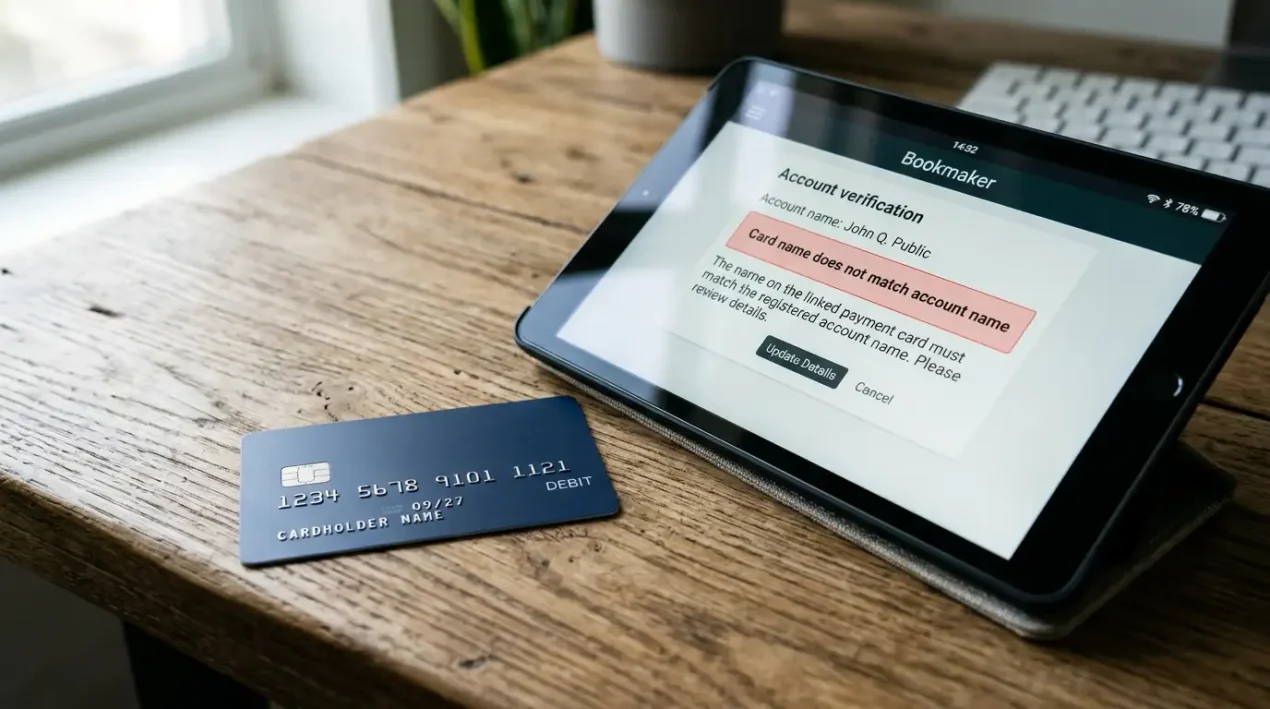
The deposit that won’t clear because of one initial
The most common verification headache I hear about isn’t a wrong CVV or a declined transaction – it’s a name mismatch between the punter’s Visa card and the bookmaker account. Sometimes the issue is genuinely cosmetic, like a missing middle initial or a hyphen rendered differently across two systems. Sometimes it’s a more substantive gap, like a married name on the bookmaker account and a maiden name on the card. And sometimes it’s a third-party situation, where the cardholder and the account holder are two different people, which is the scenario AUSTRAC’s framework treats most strictly.
Operators have become considerably more careful about name matching since the 29 September 2024 pre-creation verification rules took effect. The previous practice – where small mismatches were resolved by support staff with minimal friction – has been replaced by a more cautious posture, where any mismatch tends to trigger a documentation request. The effect on punters is that what used to be a five-minute fix now sometimes takes days, and in third-party cases the deposit may be refused outright.
This piece walks through why name matching has tightened, what counts as an acceptable mismatch versus a refusal-worthy one, and how to resolve the documentation when your card and your account don’t line up.
Smooth registration starts on our homepage.
The AUSTRAC framework and why name match matters
The Anti-Money Laundering and Counter-Terrorism Financing Act and its associated rules require that the customer using a designated service is the same person whose identity has been verified. For wagering services, the customer is the account holder, and the source of funds for deposits has to be traceable to that customer. A mismatched card name raises a structural question: is the deposit coming from the account holder, or from somebody else?
If the deposit is from somebody else, the operator is potentially facilitating third-party transfers, which sit outside the customer’s verified identity. AUSTRAC’s framework treats third-party deposits as a higher-risk category that requires additional verification or refusal. This is why operators have moved to refuse mismatched deposits rather than process and review – the regulatory cost of getting it wrong is high enough that the cautious default is refusal.
The 2024-25 ACMA compliance work reinforced this posture. ACMA’s review caught fifty operators with non-compliant terms and conditions and required remediation by 30 June 2025, and the broader signal to the industry was that the regulator’s tolerance for verification gaps had narrowed. Operators have priced this in by tightening their name-matching logic.
What counts as an acceptable cosmetic mismatch
Not every mismatch is treated the same. Operators generally have tolerance bands for what they consider cosmetic variations versus substantive differences. The cosmetic side typically includes a missing middle initial (where the card shows “John A Smith” and the account shows “John Smith”), differences in capitalisation, the presence or absence of a hyphen in a double-barrelled surname, and accents on letters that the card system has rendered without diacritics.
These cosmetic mismatches usually clear automatically through the operator’s name-matching algorithm, which tolerates reasonable variation. If they don’t clear automatically, a single piece of supporting documentation – usually a bank statement showing the full name as registered with the issuer – is enough to resolve the case. The processing time is typically same-day, sometimes within a few hours during business hours.
The substantive side is different. A married name on the account with a maiden name on the card requires evidence of the name change – a marriage certificate, a deed poll, or a passport showing the new name. A completely different name (cardholder Jane, account holder John) is treated as a third-party transaction by default and refused unless the relationship can be documented through a joint account or supplementary cardholder structure.
Joint cards and supplementary cardholders
The most common substantive mismatch comes from joint accounts and supplementary cards. A joint Visa Debit card might be issued in two names – the primary holder and the secondary holder – but only one of those names appears on the embossed card itself. If the primary holder opens a bookmaker account and the secondary holder tries to deposit using a card that shows the primary holder’s name, the operator’s first read is a third-party deposit and the deposit is refused.
The resolution path requires documentation of the joint structure. The bank can issue a letter or statement confirming both account holders, and once the operator sees this evidence, the deposit is generally allowed – but with one important caveat. The operator typically requires that the bookmaker account is also held in joint names, or that the card-holder is the primary account holder. Mixed-structure deposits (joint card, single bookmaker account in the secondary holder’s name) sometimes get processed and sometimes don’t, depending on the operator’s risk policy.
Supplementary cards are a slightly different case. A supplementary card has a different name embossed on it but the same underlying account as the primary cardholder. Operators that recognise the supplementary structure will accept these deposits with appropriate documentation. Operators that don’t will refuse, and there’s no easy workaround beyond using a card in the account holder’s own name.
Married names, deed polls and passport updates
A common mismatch is the married-name versus maiden-name gap. The cardholder updated her bank records when she got married, and her card now shows her married name, but her bookmaker account was opened years earlier under her maiden name and never updated. The deposit fails the name-match check, and the operator asks for documentation.
The acceptable evidence is usually a marriage certificate or a deed-poll document showing the name change, accompanied by current photo identification (typically a driver’s licence or passport) showing the new name. Operators that have processed these cases routinely will resolve them within a business day; operators that handle them rarely sometimes take longer because the support team has to escalate to a compliance reviewer.
The simpler long-term fix is to update the bookmaker account to match the card. Most operators allow account-name updates with the same documentation, and once updated the mismatch is permanently resolved. Punters who don’t want to do this – perhaps because they prefer to keep the account in their previous name for personal reasons – can keep providing the documentation each time, but every name-mismatch review is a potential delay.
Card-holder versus account-holder discrepancies
The most difficult mismatch is the genuine third-party case: the cardholder and the account holder are two different people, with no joint or supplementary structure linking them. The most common version is a partner depositing on behalf of the account holder using their own card. Operators almost universally refuse these deposits as third-party transactions, and the refusal is built into the AUSTRAC framework rather than being an operator preference.
Even with consent – written authorisation from the cardholder, or a statutory declaration confirming the relationship – the deposit usually won’t be processed. The operator’s compliance position is that source of funds must be traceable to the verified account holder, and a different person’s card breaks that trace regardless of what permissions exist between the two parties.
The workaround punters sometimes try is to transfer the funds from the partner’s card to the account holder’s bank account first, then deposit from there. This works because the funds, once in the account holder’s bank, are the account holder’s money for verification purposes. But it adds friction and time, and operators that look closely at deposit patterns may notice the structure and ask follow-up questions about source of funds.
The documentation pack that resolves most cases
For cosmetic mismatches and most married-name cases, the documentation pack is straightforward. A photo of the card (with all but the last four digits and the CVV obscured), a bank statement or letter showing the full registered name on the account, and current photo identification. Operators with mature verification workflows will process this pack within hours.
For joint-card cases, add a bank letter or statement confirming the joint structure. For deed-poll cases, add the deed-poll document. For overseas-issued cards (which create a different category of mismatch where the card is in the holder’s name but in a different alphabet or transliteration), add a translation or an apostille if the operator requires it.
The 96% smartphone penetration rate among 18-to-64-year-olds in Australia means most punters can complete the documentation upload from their phone in under ten minutes. The bottleneck is on the operator side, where compliance reviewers process the documents and approve the deposit. During peak periods (race days, major sporting weekends, end of financial year) the processing queue can extend to several days, which is worth knowing if a deposit is time-sensitive.
What to do before opening a new account
The cleanest way to avoid name-mismatch delays is to make sure the bookmaker account is opened in exactly the name shown on the Visa card the punter intends to use. If the card shows a middle initial, include the middle initial. If the card uses a hyphen in a double-barrelled surname, use the hyphen. If the card was issued before a name change, decide upfront whether to use the new name (and document the change) or the old name (and update the card later).
For punters who hold cards in multiple names – a personal card, a joint card with a partner, a supplementary card on a parent’s account – the simplest path is to use only the personal card for bookmaker deposits and avoid the joint and supplementary cards altogether. The deposit limits of the personal card are usually adequate for ordinary punting, and the verification path stays simple.
For punters who genuinely need to deposit from a joint account, opening the bookmaker account in joint names is usually the cleanest option, even though it’s less common. Most operators support joint accounts, and once the joint structure is documented at account creation, deposits from either holder’s card clear without name-mismatch friction.
What name mismatch tells operators about a deposit
From the operator’s compliance perspective, a name mismatch isn’t just a verification problem – it’s a risk signal. The operator’s risk model treats first-time mismatches as low-risk (probably a married-name issue or a cosmetic gap), but repeated mismatches across different cards are treated as higher risk because they suggest either third-party deposits or potentially that the account is being used by somebody other than the verified holder.
Secure your account by following the KYC requirements for Australian bookmakers.
Punters who deposit from multiple cards in different names – even with all the documentation – sometimes find that the operator’s risk model flags the account for closer review. The review might result in additional source-of-funds verification, deposit limits being lowered, or in extreme cases the account being closed. None of these outcomes is automatic, but the pattern of multiple-card mismatches is one of the things compliance teams notice.
The simplest defensive posture is to deposit from one card consistently, in the same name as the account, with the documentation pre-uploaded if any cosmetic mismatch exists. Punters who do this rarely encounter friction. Punters who experiment with different cards across different names tend to encounter it repeatedly, and each encounter generates a record that compounds in the operator’s risk view. For more on the same regulatory frame, the KYC and ACIP framework that operators apply to verify Visa punters covers the adjacent ground.
If my card name is in capital letters but my bookmaker account is in mixed case, will the deposit fail?
No. Capitalisation differences are universally treated as cosmetic and don’t trigger a verification review at any major operator. The name-matching algorithm normalises case before comparing.
Can I deposit from a card issued overseas in a different transliteration of my name?
Sometimes – it depends on the operator and the documentation. Cards from non-Latin-script regions (where the holder’s name is transliterated) often clear with a passport showing both the original and Latin-script versions of the name. Without the passport evidence, operators are likely to refuse.
My partner and I share finances. Can we get one bookmaker account that we both deposit into?
Yes, by opening the account in joint names from the start. Both holders are verified at account creation, both names appear on the account, and either holder’s card can be used for deposits. Adding the second holder later is harder and may require the account to be closed and reopened.
